Swamp Thing 77 (October 1988)

16047.jpg
Did someone forget to tell Jamie Delano Abby is from Eastern Europe? She’s got a line about being a nervous sixteen year-old and it doesn’t seem very appropriate, given her Iron Curtain upbringings.

Actually, the guest crew of Delano and Tom Mandrake (Alcala’s on inks still) mimic Veitch so well I had no idea he didn’t write or draw it until I went back and looked. It’s a nice interlude issue, with Abby and Alec fighting a bit after her “night” with Constantine.

Delano takes his time with the pacing, following Abby through a rough day. Mandrake layers in some surprises. It’s a lovely issue, actually–it’s surprisingly two guest creators could do such a seamless, significant job.

Constantine shows up for a bit too, which would be more contrived if Delano and Mandrake didn’t introduce him so well. They slickly infer his presence before his appearance.

Excellent stuff.

CREDITS

Infernal Triangles; writer, Jamie Delano; penciller, Tom Mandrake; inker, Alfredo Alcala; colorist, Tatjana Wood; letterer, John Costanza; editor, Karen Berger; publisher, DC Comics.


Contemporaneously…

Hellblazer 8 (August 1988)

8202.jpg
All of a sudden, Delano seems to decide he needs to make the comic about Constantine. Not immediately, of course. He opens with a little about the cultists kidnapping Constantine’s lady friend, though she’s been reduced to a chess piece at this point.

Then Constantine hallucinates–and Delano gives the reader some hints of the backstory (a botched exorcism)–and finally wakes up to discover himself in a hospital bed.

Apparently Swamp Thing, in an offscreen moment, got Constantine to the doctor. This scene, with Swamp Thing somehow delivering a crushed Constantine to the emergency room door, would be better than anything else in the issue.

Anyway, a demon shows up and tries to get Constantine to join his side against the Christian fundamentalists. Delano amusingly puts the blame not on the fundamentalists… but insensitive angels. The details are interesting, but they don’t make a story.

Still, the writing’s decent.

CREDITS

Intensive Care; writer, Jamie Delano; penciller, John Ridgway; inker, Alfredo Alcala; colorist, Lovern Kindzierski; letterer, John Costanza; editor, Karen Berger; publisher, DC Comics.

Hellblazer 9 (September 1988)

8203.jpg
What’s with Delano and all the globe trotting? It gets outrageous this issue, with Delano carting Constantine over to Gotham to have it out with his ghosts. He’s upset he’s got demon’s blood running through his veins, but only because one of his ghosts explains that condition to him. The way Delano writes it in scenes, he’s just drunk and depressed.

So if Delano’s going for subtle, he goes way too far. Hellblazer is so subtle, it could put the reader to sleep.

It turns out Constantine is trying, but not in his internal monologue, to figure out what to do about his girlfriend. Delano has been very dramatic and action-oriented with her story so far; the presumed resolution is muted (if artistically stylish). It’s also bloody obvious. Constantine should’ve had the idea immediately.

The end cameo from tobacco Swamp Thing is the best thing and it’s terribly written.

CREDITS

Shot to Hell; writer, Jamie Delano; penciller, John Ridgway; inker, Alfredo Alcala; colorist, Lovern Kindzierski; letterer, Todd Klein; editor, Karen Berger; publisher, DC Comics.

Hellblazer 7 (July 1988)

8201.jpg
This issue, rather inappropriately, feels like a rip-off of a Swamp Thing standard. Well, I think Moore did it once and Veitch did it once, but it’s still a standard. There’s no supernatural situation of the week this issue, instead a friend of Constantine hacks into the evil fundamentalist’s computer network but he does so via hallucinogenic and technology suction cupped to his forehead.

Delano and Ridgway spend most of their effort on this journey through the computer world–pre-Internet, post-Tron–and it feels just like when Moore (and Veitch) send Swamp Thing through the Green. Given Hellblazer‘s a spin-off of Swamp Thing… it just feels rather cheap.

And the whole issue turns out to be a way for Delano to focus on Constantine for the last five pages instead of the melodrama.

The writing’s fine, the art’s fine, but it’s a waste of time.

CREDITS

Ghosts in the Machine; writer, Jamie Delano; pencillers, Brett Ewins and John Ridgway; inkers, Jim McCarthy and Ridgway; colorist, Lovern Kindzierski; letterer, Todd Klein; editor, Karen Berger; publisher, DC Comics.

Hellblazer 6 (June 1988)

8200.jpg
After last issue’s trip to America, Constantine is back–without explanation–in London. Luckily, he stumbles into a situation where he can learn more of the B plot.

Delano’s story is somewhat lame, but at least it features Constantine in a substantial role. It ties a little into Swamp Thing, but in a slight way. What Delano choses to share with that book is almost more interesting than the issue itself.

What is interesting, however, is Delano’s attention to the AIDS crisis and a comedic bit about football hooligans. Hellblazer feels British, an informed (if amplified) British.

Delano uses all of the business and revelations of the villain (one of them) to disguise the lack of plot. Constantine and his lady friend get in some trouble. The football stuff, the AIDS stuff, the villain stuff… it emptily fills pages.

It’s also annoying how Delano writes Constantine constantly talking to himself.

CREDITS

Extreme Prejudice; writer, Jamie Delano; artist, John Ridgway; colorist, Lovern Kindzierski; letterer, Todd Klein; editor, Karen Berger; publisher, DC Comics.

Hellblazer 5 (May 1988)

8199.jpg
Delano name drops Swamp Thing early on this issue. Maybe he’s trying to remind readers why they picked up this book in the first place, maybe he’s trying to remind them Constantine is actually a character. Because he’s useless in this issue of Hellblazer. Besides whining about being a coward in his internal dialogue and interceding once… he’s pointless in his own book.

This issue is a horror comic about Vietnam. I’ll bet it’s not the first of its kind, with a guy going nuts and the outcome being terrible.

While Delano does tie it into the B plot about a fundamentalist, capitalist church being up to no good, it could stand alone. In fact, it would be stronger if it did stand alone because then Delano could have spent time establishing characters.

The scenes are competent enough and Ridgway’s art is fine, but Delano’s unable to define the comic.

CREDITS

When Johnny Comes Marching Home; writer, Jamie Delano; artist, John Ridgway; colorist, Lovern Kindzierski; letterer, Todd Klein; editor, Karen Berger; publisher, DC Comics.
Hellblazer 4 (April 1988)

8198.jpg
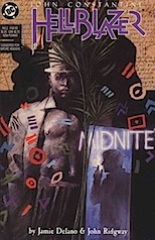
Delano’s way too tricky a writer for a monthly comic. He introduces a new character–the guest star who’s apparently the subject of the issue. Hellblazer, at least so far, has a supernatural gimmick of the week.

Then Delano moves over to Constantine. He’s having a night on the town, which doesn’t exactly play into the issue’s story. He meets a girl, who also doesn’t exactly play in. She’s superfluous, unless Constantine just desperately needs a girlfriend or a sidekick.

He doesn’t.

Anyway, it turns out the story’s only a story because of how the guest star relates to Constantine. Otherwise, none of it would have any impact on Constantine’s life.

The issue ends with Constantine realizing something’s been going on and he’s been too distracted to notice. Except he hasn’t been distracted, Delano has just been writing him dumb.

It’s not a bad horror comic, but it’s nothing special.

CREDITS

Waiting for the Man; writer, Jamie Delano; artist, John Ridgway; colorist, Lovern Kindzierski; letterer, Annie Halfacree; editor, Karen Berger; publisher, DC Comics.

Hellblazer 3 (March 1988)

8197.jpg
Well, Delano certainly can write a lame comic. The writing itself isn’t so bad, it’s Delano’s plot and most of the characterizations. He also requires Constantine to be stupid for a while.

The issue ties into British politics, specifically Margaret Thatcher being about as bad as the demon of flatulence. Actually, wait, I think she’s supposed to be worse. The demon of flatulence is kind of funny and he’s not as evil.

Constantine stumbles across a bunch of demons running an investment firm and grabbing the souls of their human customers. Since he’s basically a good guy–especially this issue–he stops them. There’s very little drama to the comic, since Constantine isn’t going to die in his third issue and there’s pretty much no one else human in the comic.

A waiter, maybe.

Delano does write a good scene about Constantine’s contacts.

Ridgway’s art is occasionally weak, but passable.

CREDITS

Going For It; writer, Jamie Delano; artist, John Ridgway; colorist, Lovern Kindzierski; letterer, Annie Halfacree; editor, Karen Berger; publisher, DC Comics.

Hellblazer 2 (February 1988)

8196.jpg
This issue’s rather surprising. There’s no conflict to it. And when I say no conflict, I mean none.

It finishes up the story from the first issue, has Constantine encounter some more ghosts–all of whom are from Swamp Thing and Delano doesn’t write Constantine at all the same as Alan Moore did so there’s a disconnect–but it’s just a closer.

I feel like I should be disappointed, but I’m really not. Delano finishes the first story. It’s not his fault there’s no drama in it. I suppose if it weren’t all so predictable there might be drama. It is his fault it’s predictable, but to make it unpredictable, he would have either needed a third issue or a shorter first.

Ridgway’s a bit of a disappointment though. I get he’s being frantic with all the lines to increase intensity, but the scenes’re intense enough.

Hellblazer‘s fine, just disaffected.

CREDITS

A Feast of Friends; writer, Jamie Delano; artist, John Ridgway; colorist, Lovern Kindzierski; letterer, Annie Halfacree; editor, Karen Berger; publisher, DC Comics.

Hellblazer 1 (January 1988)

8195.jpg
I’m not sure how seriously Jamie Delano takes Hellblazer. Well, maybe he takes the story seriously, but not John Constantine. The issue opens with a demonic incident–bugs, since it’s a Swamp Thing spin-off, but to be bugs–and it takes a while for Constantine to show up.

When he does, Delano’s writing style changes. He intentionally gets very purple with adjectives, he’s got Constantine talks very British to himself. Maybe the humor is to offset the grossness.

But the plot is also a little goofy. Constantine’s a globe-trotter. He starts in London, heads to Africa for some investigating, then to New York. While Delano ties the New York setting into the character’s history well enough, it’s hard not to think the stateside setting is for the U.S. comic market.

John Ridgway’s art is good. He gives the various settings a lot of personality while maintaining general uneasiness.

CREDITS

Hunger; writer, Jamie Delano; artist, John Ridgway; colorist, Lovern Kindzierski; letterer, Annie Halfacree; editor, Karen Berger; publisher, DC Comics.