
Until the last story, which might be the least impressive entry in an issue of unimpressive entries… I think the most successful art, overall, in the issue is Ernie Chan’s one-pager. It opens the issue, with a Tony Isabella script, all about the various ways of killing vampires. It’s amusing and practical; statements it’s difficult to make about the rest of the issue.
The first story’s the most disappointing, just because it continues Doug Moench’s okay “Dracula vs. the NYPD” story from the previous issue. This time Frank Robbins is penciling with Frank Springer inking. It’s a cartoony style, with disappointing character work. Not sure if it’s Robbins or Springer, but the people look lousy. Neither good nor bad is Dracula, who’s more inhuman. The story involves Dracula tracking down the guy who looted his castle and having to figure out how to get his wares back.
Meanwhile, the cop whose wife Dracula killed last issue is out to get him. His fellow cops believe his story of a vampire forcing the guy to kill his own wife, which tracks. Imagine what police accountability was like in the seventies.
Interestingly, Dracula’s still a somewhat mythic figure, with the lady who buys his stuff at auction (seriously, hasn’t another Tomb story used this bit) wishing he were real. Well, she finds out.
For a panel, it seems like the Franks are at least enthusiastic about good girl art but then not really.
The disappointing art sets the tone for the rest of the issue, with the most personally disappointing coming up next. It’s another Moench story (there are four features, one movie review, and a letters page, yet another change of regular content), with art by twenty-one-year-old Paul Gulacy and inks by Mike Esposito. It’s about Dracula versus some other vampire; this other vampire’s terrorizing a European village, which pisses Dracula off because it means no easy feeding there.
I’d love to say baby Paul Gulacy has the chops.
He does not. He’s got better panels and worse panels, and you can see proto-Gulacy at work (even the almond eyes), but you can’t really see how good he’ll get from this one.
The story’s got a strange finish, kind of jokey. What’s more bizarre is the other two stories have the same kind of finish.
They have a different writer, though—Gerry Conway.
His first story has Alfredo Alcala art. Alcala’s a better inker than penciller and inker. His faces are flat in the wrong places, and his figures are strange. His backgrounds are fantastic. The story’s about a young couple; the evil girl convinces the boy to rob a jewelry store for her.
Meanwhile, Dracula’s around. Their paths cross. Unlike the Moench story, this one begins and ends with light humor. It’s a weird tone, especially with the art. The whole issue just feels off.
The last story—the only one where the art’s more successful than that Chan one-pager—is about a mysterious figure in a top hat hunting Dracula. Sonny Trinidad does the art. The art’s good. The story’s terrible. Conway takes a big swing with it and completely misses. So again, the issue feels off, especially with usually sturdy (on Lives anyway) Conway fumbling both his stories. Moench’s got more art problems, so it’s hard to say. But Conway’s stories go wrong because of the writing.
The movie review—by Gerry Boudreau—covers the Hammer Dracula film, The Scars of Dracula. Boudreau hates it, though with less personality than Moench or Isabella had in their previous reviews.
No Bram Stoker’s Dracula adaptation here.
Unfortunately—and unexpectedly—I’m back to wondering if Lives is worth it again.
 With Chuck Patton helping, the pencils are occasionally tolerable. Even Alcala inking can’t fix whatever Hoberg does wrong with Batman’s cowl, unfortunately.
 After my many complaints Moench never writes Bruce Wayne at length (and sensible, as he did write him at length and ludicrous during the Jason Todd adoption thing), he dedicates an entire issue to Bruce.
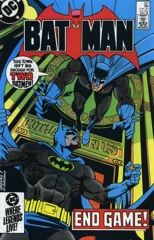 Moench neatly ties everything together–including Bruce setting up Nocturna for an unnecessary fall–and it’s hard to remember why any of the threads are important at all. They weren’t important to the characters, except Nocturna (and maybe Alfred); Moench’s frantic pace keeps the issue engaging but it’s not fulfilling in any way.
 What an odd turn of events. One can’t help but note Moench is following a number of story beats–corrupt politician, villain masquerading as Batman–Gerry Conway did immediately prior in his lengthy run, not to mention other writers before them.
 It’s a crazy issue. The last half has not just Robin telling Nocturna he’d love her as a man would if he were older, it’s got Batman blathering on to her about… no, I’m wrong. That thing with Robin telling his newly adopted mother he’d have the hots for her, Moench never tops that one.
 I’m kind of hoping Moench’s got a good back story saved up for Nocturna. She gets what I think is her first interior monologue–if not first, first significant one she’s come back–where she’s questioning her motives. There are hints at some strange origin. It would help.
 What an issue. How to even start. Okay, so Moench is having so much trouble figuring out why Bruce Wayne wants to adopt Jason Todd, he actually has a scene where Nocturna “tempts” him with the promise of a ready-made family.
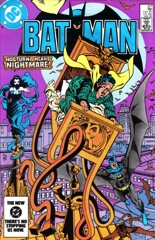 Moench runs directly into that Bruce Wayne problem he’s been having for a while. He has to have Bruce decide he wants to sneak around with Nocturna; it comes after a lengthy conversation with Alfred. Moench does fine with that conversation–the art from Newton and Alcala is fantastic, Newton’s compositions this issue are amazing–but he hasn’t established any of Bruce’s romances well.
 Wow, what’s Moench thinking? He’s done some great, ambitious stories since he started writing the Batman comics but… a supervillain adopting Jason Todd? Noctura is back–she looks like a vampire, something I assume they came up with for Gene Colan–and she wants to adopt Jason.